· Reviews · 8 min read
How to Get More Google Reviews as an HVAC Company
A practical guide for HVAC businesses who want more Google reviews — how to turn seasonal demand, emergency calls, and maintenance visits into a steady stream of five-star reviews.
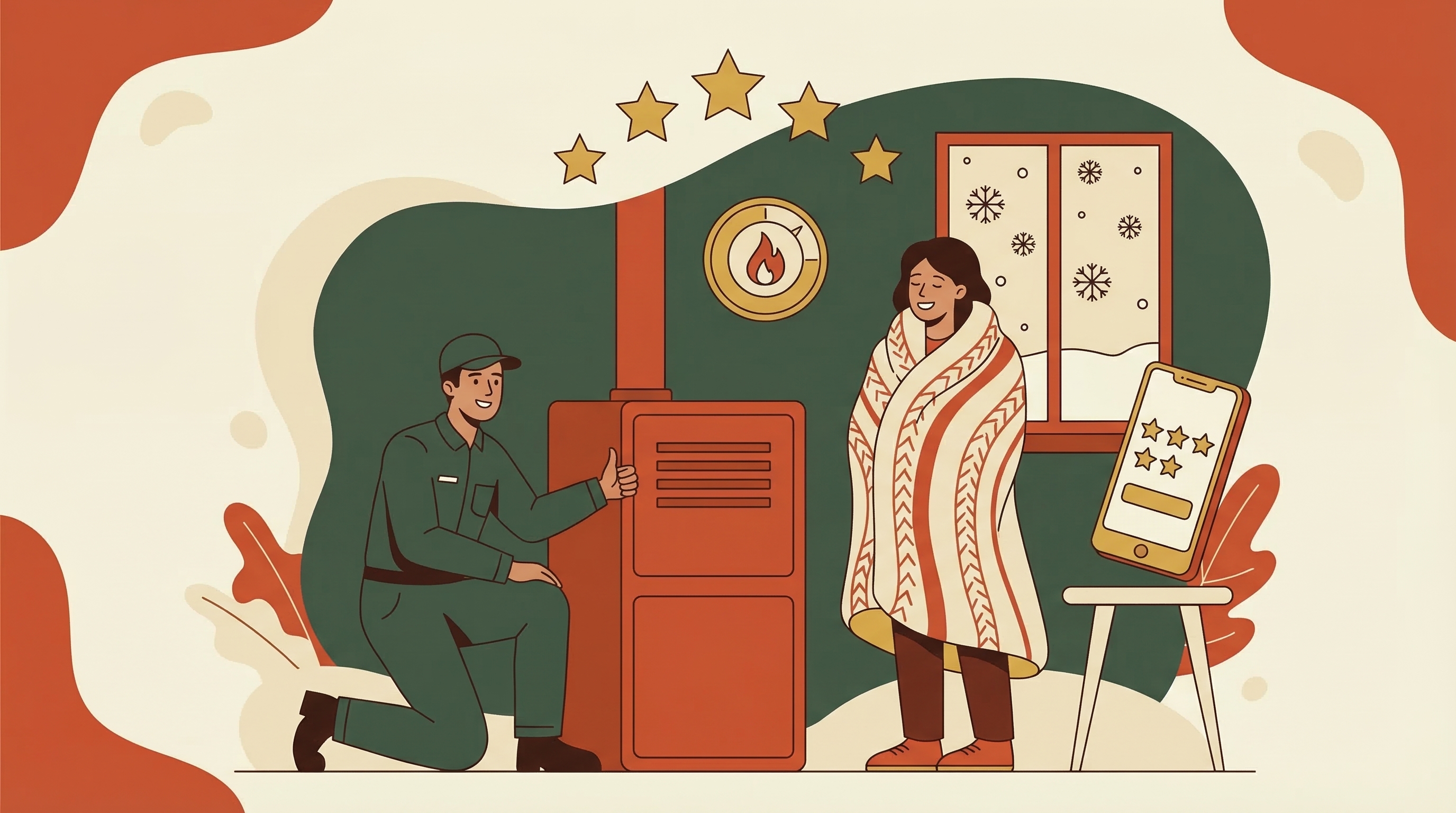
HVAC businesses have a seasonal advantage that most trades don’t: twice a year, demand spikes and your phone rings nonstop.
The first heat wave of summer. The first cold snap of winter. Furnaces that won’t start. Air conditioners that blow warm air. These aren’t optional repairs — they’re emergencies. When a family’s house is 95 degrees inside and you show up, diagnose the problem, and get the AC running again, they’re not just satisfied. They’re grateful.
That gratitude is the foundation of a strong Google review profile. And HVAC companies are uniquely positioned to build one, because you get two distinct seasons of high-emotion, high-urgency calls every single year.
93% of consumers read online reviews before hiring a local service provider. For HVAC specifically, the decision often happens fast — the house is uncomfortable and getting worse, and the homeowner needs someone now. They’re going to search, scan the top results, read a few reviews, and call whoever looks most trustworthy. If your review profile is thin or outdated, you’re losing calls to the competitor with 200 reviews and a 4.8-star rating.
When to Ask: Timing for HVAC Reviews
Emergency repair calls (your best opportunity)
When someone’s furnace dies in January and you restore heat to their house, you’ve just become their favorite person. The emotional contrast — from freezing and panicking to warm and relieved — is incredibly powerful. Ask for a review before you leave the house or within an hour of leaving.
Emergency calls consistently produce the best reviews in the HVAC industry. The customer is emotional, grateful, and eager to tell others about their experience.
After a full system installation
A new furnace or AC unit is a $5,000 to $15,000 investment. The customer has been researching, getting quotes, and worrying about the cost. When you install the system, walk them through how it works, and they feel that first blast of perfect air, the relief is real. This is a great time to ask.
At the end of a maintenance visit
Seasonal tune-ups are lower-stakes, but they still generate reviews — especially if you found and fixed a potential problem. “We caught a cracked heat exchanger before it became dangerous” is the kind of thing that makes a customer feel lucky they called you. If you can frame the visit as having prevented a future emergency, the customer is more motivated to review.
After resolving a comfort complaint
Sometimes the call isn’t an emergency — it’s “the upstairs bedrooms are always too hot” or “the system runs constantly but the house never gets comfortable.” These diagnostic challenges, when solved, produce great reviews because the customer has been living with the problem for a while. Fixing a long-standing comfort issue feels like a bigger deal than fixing an acute one.
When NOT to ask
Don’t ask when the repair was more expensive than quoted. Don’t ask when you had to order a part and come back. Don’t ask during the busy season when the customer had to wait three days for an appointment and is already frustrated. Fix the situation first, then ask.
For a deeper look at timing, read our guide on how to ask customers for reviews.
What to Say: Review Request Templates for HVAC
In person, after an emergency repair
“I know it was miserable in here — glad we got the heat back on. If you get a chance later today, a Google review would really help us out. When it’s freezing outside and someone’s searching for an HVAC company, hearing from someone who’s been through what you just went through makes a big difference.”
Via text, 1-2 hours after a service call
“Hi [Name], this is [Your Name] from [Business]. Glad we could get your AC running again today. If you’re cooling off nicely, would you mind leaving us a quick Google review? Here’s the link: [link]. It really helps our small business. Thanks!”
Follow-up text (48 hours later)
“Hi [Name], just checking in — is the new thermostat working well for you? If so, we’d really appreciate a Google review when you have a minute: [link]. Hope you’re staying comfortable!”
Each template references the specific work. “Got the heat back on,” “AC running again,” “new thermostat.” This matters because it helps the customer write a detailed review, and detailed reviews contain the keywords that boost your local SEO — things like “furnace repair,” “AC installation,” and “HVAC emergency.”
For more templates, check out our full post on how to get more Google reviews.
Seasonal Strategy: How to Build Reviews Year-Round
HVAC businesses have a natural review-building rhythm that other trades don’t. Here’s how to use it:
Spring (March-May): AC tune-up season. Every maintenance visit is an opportunity. You’re doing 5-15 tune-ups a day during peak weeks. Even a 10% review conversion rate generates a surge of new reviews heading into summer.
Summer (June-August): Emergency AC calls spike. These produce your most emotional, detailed reviews. Prioritize asking after every emergency call — the conversion rate is significantly higher than routine work.
Fall (September-November): Furnace tune-up season. Same playbook as spring. Volume is high, and customers are proactive about heating before winter.
Winter (December-February): Emergency heating calls spike. Same dynamic as summer emergencies — high emotion, high gratitude, high review conversion.
This means you have four distinct review-generating seasons every year. If you’re consistent about asking, you’ll add reviews steadily rather than in bursts, which Google’s algorithm prefers.
QR Codes for HVAC Companies
On the equipment sticker
This is the HVAC-specific play that most companies miss. When you install or service a furnace or AC unit, leave a sticker on or near the unit with your company name, phone number, and a QR code linked to your Google review page. The homeowner will see it every time they change the filter or check the system.
On invoices and receipts
Whether you print invoices on-site or email them, include a QR code. The customer looks at the invoice when they’re reviewing the cost — and if the service was good, they’re happy to leave a review right then.
Other placements
- Leave-behind cards handed to the customer after service
- Your service vehicles (parked in driveways, visible to neighbors)
- Thermostat area stickers (seen daily by the homeowner)
- Email signatures on follow-up communications
For step-by-step setup, see our guide on creating a Google review QR code.
Text Messages vs Email for HVAC Customers
Your customers are homeowners, not office workers. They’re checking their phones, not their inboxes. SMS review requests have a 98% open rate versus about 20% for email, and the response rate is dramatically higher.
For HVAC specifically, there’s an added benefit: after a service call, the customer’s phone is likely nearby and they’re settling back into a comfortable house. A text arriving an hour or two later catches them in that moment of relief and appreciation.
For the full comparison, read our post on SMS vs email for review requests.
Automating Reviews for an HVAC Business
Here’s the reality of running an HVAC company: during peak season, you’re doing 8-15 calls a day. You don’t have time to send individual review request texts after each one. And during the slow season, when you do have time, there are fewer jobs to generate reviews from.
Automation solves both problems. When a job is marked complete, an automated text goes out to the customer. If they don’t review within a couple of days, a follow-up is sent. When they do review, the messages stop and a thank-you goes out instead.
Tools like Ricorda handle this entire process — you finish the job, the review request goes out automatically. During a 15-call day in July, that’s 15 review requests you didn’t have to think about. Over a season, the reviews compound.
For more details, read our post on automated Google review requests.
Getting Started: Your HVAC Review Plan
Get your Google review link. Open your Google Business Profile, click “Ask for reviews,” and copy the short URL.
Create two text templates. One for emergency calls (“Glad we got your [heat/AC] working again…”) and one for maintenance visits (“Thanks for having us out for your tune-up…”). Save them in your phone.
Start with emergency calls. For the next two weeks, send a review request text within two hours of every emergency call. These have the highest conversion rate and will show you results fastest.
Expand to maintenance visits. Once you’re comfortable with the process, start asking after tune-ups and maintenance calls too.
Automate before peak season. Set up an automated system before the next busy season hits. When you’re doing 10+ calls a day, automation is the difference between getting reviews and missing them all.
HVAC companies that ask consistently can add 5-15 reviews per month, depending on call volume. Over a year, that’s 60-180 reviews. In most local markets, that puts you in the top tier — and the top tier gets the most calls.
68% of customers will leave a review when asked. After you’ve just restored heat to a freezing house or cooled down a sweltering one, that number goes even higher. The only thing standing between you and a dominant review profile is a consistent system for asking.